A water-filled barrier can remain upright yet slide, open at a coupling, or expose pedestrians when the pavement, fill level and layout are wrong. By the end, you will be able to diagnose those failures, specify measurable barrier requirements and check a Pune work zone after rain, relocation or vehicle contact.
Key takeaways
- Check connectors, footing friction and ground support—not just water level.
- Drain barriers before moving them; use lifting points and control the route.
- Design layouts for monsoon runoff, traffic loads and pedestrian access.
- Put inspection triggers and replacement responsibilities in the contract.
Why a Full Barrier Can Still Slide or Open
A barrier can be full and still slide or open when its footing loses friction, its line is poorly connected, or the ground cannot support its load.
Water adds roughly 1 kilogram per litre, so a 500-litre unit gains about 500 kilograms. That ballast helps only when the base sits flat and the mass acts through a stable footprint; it does not turn the unit into a self-anchored restraint.
On projects described as water filled road for barriers in pune, check these failure conditions:
- Wet asphalt, oil, mud, silt or polished pavement reduces friction beneath the base.
- Loose aggregate, paver blocks, fresh utility reinstatement or a weakened excavation edge lets the base settle or yaw.
- A crossfall, pothole or road gradient shifts the centre of gravity and directs sliding downhill.
- Monsoon runoff can pond around the unit, wash soil from the edge or deposit debris under one side.
A full line can also open at a coupling. A damaged connector, incomplete engagement, excessive line curvature or unsupported end lets upright units kink, rotate or separate during a sideways push; inspect every joint, end treatment and specified curvature, not just water level.
Finally, full does not mean crashworthy. A water-filled delineator is not a vehicle-containment barrier unless the exact configuration has an applicable impact-test classification, such as an EN 1317 result. Treat these as road barrier stability problems, not merely fill problems, and record surface, slope, coupling and drainage condition.
Fill, Drain and Move Units Without Creating New Failures
Fill units on level pavement, not beside an excavation or in moving runoff. Use clean water only if the manufacturer permits it; additives, muddy water and debris can block plugs, encourage algae and make the fill level unreliable.
Fill to the specified operating level, close every plug, and record the installation date and any unit left below that level.
Use this inspection sequence for water-filled barriers for public works:
- Check tanks, seams, plugs, couplers and lifting points for cracks, distortion, abrasion or missing parts before filling.
- Confirm every unit contains the specified volume, sits flat, and connects fully to its neighbours.
- After forklift handling, vehicle contact, heavy rain or relocation, inspect for leaks, silt deposits, shifted units and open joints.
- Mark and quarantine any cracked, leaking or distorted unit. Do not return it to the row with tape, rope or an improvised plug.
Drain and move units without dragging them across rough pavement. Empty the tank through its drain point, then remove trapped sediment and rinse it if the manufacturer allows; residual water can grow algae and freeze in colder storage conditions.
Lift from the designated points, use equipment rated for the unit’s empty weight, and keep forklift tines and loader buckets away from the tank and couplers.
Store barriers empty, upright and supported on a clean, stable surface. Keep plugs, couplers and replacement parts with the units, protect openings from insects and debris, and inspect them again before refilling.
On Pune sites, clear ponding and silt around the base after monsoon rain; wet contaminated pavement can reduce sliding resistance even when every tank is full.
Choose Ballast and Performance for the Actual Work Zone
An empty barrier suits short-duration delineation where crews need frequent relocation and vehicle containment is not required. Water provides quick ballast; sand suits sites without a dependable water supply; concrete suits a fixed installation where lifting equipment and a designed base are available.
| Option | Main benefit | Right choice |
|---|---|---|
| Empty | Lightest transport and fastest relocation | Low-speed separation, tapers or short works |
| Water-filled | Fast ballast with simple draining | Level, paved sites needing repeated layout changes |
| Sand-filled | Heavier ballast without leakage | Water access is limited and units will remain in place |
| Concrete-filled | Highest mass and removal resistance | Long-duration works with engineered foundations and lifting access |
Do not select by weight alone. A full water unit is not automatically crashworthy: high-speed approaches, bridge edges, excavations, pedestrian protection and opposing-traffic separation require a tested rigid or anchored system. Match the tested configuration, unit spacing, terminals and anchorage to the impact condition; request an applicable EN 1317 impact-test result when containment is claimed.
Specifications for water filled traffic barriers for municipalities should require:
- Empty and filled mass, water capacity, base dimensions, coupling strength and permitted slope and temperature range.
- Reflectivity performance, UV warranty period, replacement plugs and other service parts.
- Drain-hole or drain-plug design, filling instructions and resistance to silt contamination.
- The complete impact-test report, including configuration, speed, vehicle type, deflection and tested spacing.
- Maximum permitted spacing, surface condition and post-rain inspection requirements for Pune sites.
Plan Pune Layouts for Monsoon Water, Traffic and Pedestrians
For temporary road barriers in Pune, draw the complete traffic and pedestrian route before placing a single unit. The plan must show tapers, terminals, sign spacing, sight distance, access openings, drainage paths and clear separation from live traffic and excavations.
A request for water filled road for barriers in Pune still needs this layout; a product row alone is not traffic control.
- Keep barriers on level, load-bearing pavement, not loose aggregate, mud, paver edges or reinstated trenches. Leave space beside drains and excavation edges so runoff does not scour the shoulder or undermine the base.
- Use a continuous, interlocked line through lane closures, but do not block junction visibility, turning paths, property access or emergency openings. Close every gap that could funnel a vehicle or pedestrian into the work area.
- At ramps and footpath diversions, provide a firm, slip-resistant walking surface, handrails where the level changes, and a route wide enough for wheelchairs. Remove barrier feet, hoses and cables from the walking line to prevent trips.
- Mark tapers and terminals with clean retroreflective panels, lamps or warning devices. Keep them visible after mud, spray and construction signs cover the plastic body.
- Inspect after heavy rain. Reopen blocked outlets, remove silt, check for sliding or ponding, and reset any unit that has moved.
At junctions, bridge edges, deep excavations or high-speed approaches, do not assume water ballast will contain an impact. Specify a tested rigid or anchored restraint when the consequence of vehicle entry exceeds a delineation device’s tested performance. Recheck the arrangement whenever traffic stages change.
Build the Inspection and Replacement Decision Into the Contract
Before opening a site, the supervisor must confirm that water filled barriers for public works match the approved layout and are ready for the stated hazard. Record the operating fill level, unit condition, coupler engagement, line curvature, terminals, access gaps, pavement condition and distance from live traffic, pedestrians and excavations.
- Check every unit for cracks, punctures, bulging, leaking plugs, distorted bases and damage from forklift tines or loader buckets. Quarantine any suspect unit; do not hide it inside the line.
- Confirm each tank contains the manufacturer’s specified operating volume, not an estimated level. An empty or partly filled unit has different stability from the supplied configuration.
- Pull-test or visually verify every interlock, then inspect the line for open joints, kinks and unapproved gaps. A failed coupler creates road barrier stability problems even when the units remain upright.
- After heavy rain, inspect for ponding, scour, soft shoulders, sediment under bases, displaced units and blocked drainage. Recheck the pedestrian route and sight lines.
- After vehicle contact, close the affected lane or work area, photograph the impact, isolate the contacted units and inspect adjacent couplers and bases before reopening.
- Replace a unit with any crack, leak, permanent distortion or unreliable connector. Replace the whole water-filled system with a tested restraint when vehicles could reach an excavation, bridge edge, opposing traffic or pedestrians at impact speeds beyond its tested use.
Vertex Road Safety Products can help a municipality document whether water filled traffic barriers for municipalities are being used as delineation or incorrectly specified as vehicle containment.
Require the contract to name the tested restraint configuration, including its impact classification, spacing, anchorage and terminal treatment; an EN 1317 result applies only to the configuration actually tested.
Related product
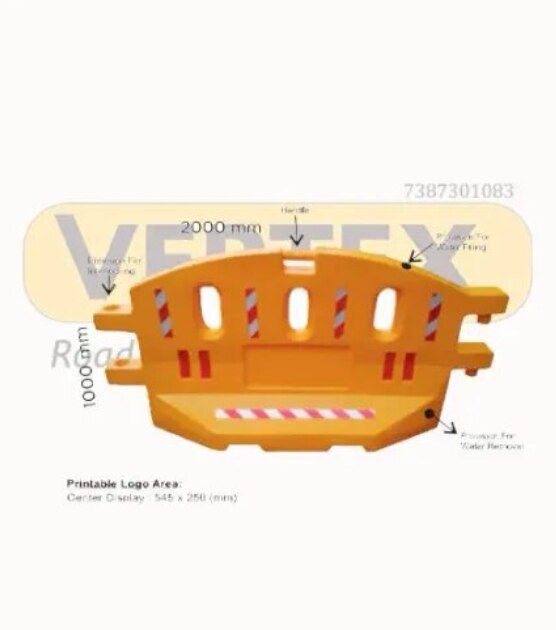
 | Vertex Water Filled Road Barriers Vertex Water Filled Road Barriers Vertex Water Filled Road Barriers are high-visibility safety barriers designed to protect pedestrians from slow-moving vehicles such as cars, vans,... View product → |
Frequently asked questions
Why can a full water-filled barrier still slide or open?
A full barrier can slide when the footing loses friction or the ground cannot support its load. A line can open when connectors are incompatible, damaged or left improperly engaged.
How should you fill, drain and move water-filled barriers?
Fill units on their final, level alignment and confirm the fill opening is sealed. Drain them before moving, use the manufacturer’s lifting points and avoid dragging units across uneven ground.
How do you choose ballast for a public works barrier?
Choose the ballast and barrier geometry for the actual work-zone hazard, vehicle speeds, impact exposure, available footprint and required visibility. Do not treat maximum water capacity as proof of stability.
What should Pune work-zone layouts account for during the monsoon?
Provide routes for runoff, prevent standing water beneath the barriers and preserve sightlines. Keep pedestrians separated from traffic and maintain accessible, unobstructed crossings.
What should the barrier inspection and replacement clause include?
Specify inspection frequency, connector and body checks, leak and deformation limits, responsibility for records, and replacement triggers after impact or visible damage.
Keywords