A stainless-steel tube can guide pedestrians, control parking or form part of a tested vehicle barrier, but those are different products with different foundations and evidence. By the end, you will know which grade, format, dimensions, spacing, impact documentation and installation details to demand from a Pune supplier.
Key takeaways
- Classify the site as decorative, access-control or vehicle-impact protection.
- Choose fixed, removable or powered bollards before setting dimensions.
- Treat crash performance as a tested bollard, foundation and installation system.
- Demand foundation drawings, spacing details and a complete handover pack.
Start with the site exposure and the job the bollard must perform
Classify the job before choosing the stainless-steel specification: decorative, pedestrian and parking control, or vehicle-impact protection. A polished tube can guide people and deter parking, but it is not a crash-rated barrier.
| Exposure | Suitable grade | What to check |
|---|---|---|
| Sheltered entrance or covered walkway | SS 304 | Lower contamination; maintain welds and surface finish |
| Open Pune site with monsoon rain, road spray or industrial pollution | SS 304 or SS 316 | Choose 316 as contamination and cleaning intensity increase |
| Pool area, chloride contamination, saline air carried inland from the coast or aggressive chemical wash-down | SS 316 | Molybdenum improves resistance to chloride corrosion |
A stainless steel bollard supplier in Pune should state these details in the quotation:
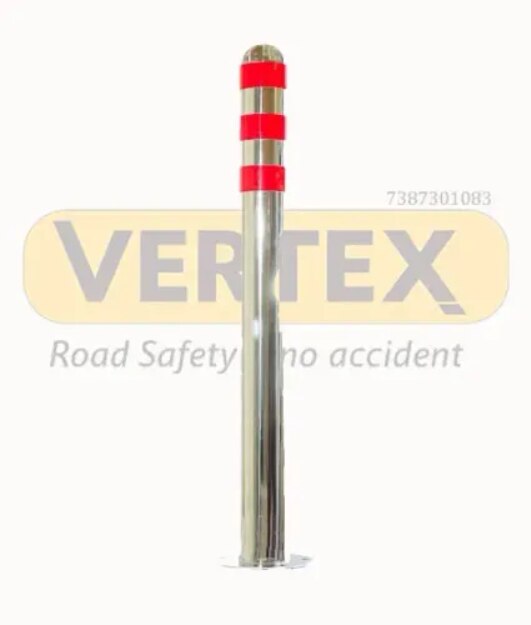
- Stainless grade, outside diameter, wall thickness, height above finished ground, finish and cap construction
- Base-plate or socket arrangement, total weight and grade certificate where procurement rules require one
- Whether the post only guides vehicles and pedestrians or must resist a vehicle impact
- For impact protection, the test standard, vehicle mass, impact speed, penetration result and approved foundation
Treat “heavy duty” and “high security” as marketing descriptions until the supplier identifies a standard such as ASTM F2656 or an equivalent vehicle-security-barrier standard. The rating applies to the complete tested post, anchors, reinforcement, concrete foundation and spacing—not to a stainless-steel tube alone.
Compare fixed, removable and powered formats before choosing dimensions
Match the bollard format to how often vehicles must cross the protected edge: fixed units suit a permanently closed boundary, while removable or powered units suit planned access.
| Format | Access routine | Main trade-off |
|---|---|---|
| Fixed | Maintenance access is rare and the edge stays closed | Simplest construction, with fewer locks, moving parts and drainage problems |
| Removable | Emergency, event or service vehicles need occasional passage | Requires a socket, lock and safe storage for the removed post |
| Fold-down or manual retractable | Controlled access is needed without electrical equipment | Requires space, hinges or mechanisms that need inspection |
| Automatic retractable or telescopic | Entrances open repeatedly through a gate, reader or remote command | Adds electrical or hydraulic equipment, drainage and maintenance |
Compare more than visible height. Confirm the outside diameter, height above finished ground level, wall thickness, base-plate dimensions and total weight. Set finished height against site vehicles: cars, two-wheelers, delivery vans and reversing trucks give drivers different sightlines. Record whether the quoted height excludes the base plate, sleeve or cap.
For stainless steel bollards in Pune, require a drawing of the complete assembly, including socket depth, anchor pattern and service clearance. Otherwise, the civil contractor may build a footing around a post that cannot be installed, removed or serviced.
Treat vehicle-impact claims as a complete tested system
A stainless-steel bollard is a security bollard only when the supplier provides a recognised impact-test classification and the installed arrangement matches the tested system. ASTM F2656 identifies the tested vehicle mass, impact speed and penetration distance. Ask for those three values instead of accepting “crash rated” or “anti-ram.”
The evidence must cover the complete installation, not just the visible post:
- Post, sleeve or base plate
- Reinforcement and concrete foundation depth
- Concrete grade and anchor-bolt arrangement
- Bollard spacing and installation configuration
- Test report, penetration result and vehicle class
- Whether the test covers a fixed, removable or retractable model
- The exact outside diameter and height represented by the rating
Changing the footing, concrete grade, anchor layout or post spacing can invalidate the claimed performance. Ask for the manufacturer’s foundation drawing and compare it with the civil contractor’s proposed installation before approval.
If the supplier cites an equivalent vehicle-security-barrier standard, request the standard name, complete test report and penetration result. A decorative bollard or pedestrian-management post can control parking and protect a footpath edge without stopping a moving vehicle.
Anyone searching for a stainless steel security bollard near me should reject a claim based only on wall thickness, total weight, “high security” wording or a photograph of a steel post.
Set spacing and visibility around the actual pedestrian and vehicle paths
Measure the clear gap between bollards, not merely their centre-to-centre distance. Make the opening too narrow for the vehicle you are excluding to pass or mount the protected edge, while preserving pedestrian, wheelchair and emergency-route width.
1. At footpaths, driveways and entrances, check the gap against the actual vehicle type: car, two-wheeler, van or truck. A spacing that stops a car may still admit a motorcycle.
2. At loading bays, draw truck swept paths and reversing zones before fixing the line. Bollards inside a turning arc will be hit even when their spacing is correct.
3. Set queue bollards along the pedestrian desire line, with entry and exit points visible. Check kerb offsets, door swings, fire exits, drainage channels and CCTV views.
4. Choose post height and reflective-band position from car-driver, two-wheeler and reversing-driver sightlines. Confirm the band remains visible below camera glare and headlight glare; test the route at night and in rain.
5. Before drilling, issue a drawing showing clear gaps, finished levels, approach directions, swept paths, signs, gates and road markings. If you search “buy stainless steel bollard in pune,” reject any quotation that omits this layout check. A clear drawing prevents a structurally sound post from becoming a collision hazard.
Demand a written installation scope, foundation detail and handover pack
A quotation is incomplete if it gives one bollard price without defining the civil, access-control and reinstatement work around it.
1. Demand separate prices for the post, base plate or socket, concrete breaking, excavation, reinforcement, anchor bolts, drainage, spoil removal, surface reinstatement, traffic or pedestrian control, and electrical work for powered units. This exposes a low unit price that hides major site costs.
2. Require an installation drawing showing core drilling or excavation, concrete grade, embedment depth, reinforcement layout, anchor-bolt diameter, anchor spacing and edge distances. The installer must locate underground utilities and verify existing slab thickness and reinforcement before drilling.
3. For removable or retractable bollards, specify socket depth, lock or mechanism access, drainage and a method that prevents water collecting inside the socket. Standing water causes corrosion, freezing-related damage and seized moving parts.
4. Ask for the exact reopening condition: how long the concrete must cure and how long installed anchors need before vehicles return. Reject a traffic date that ignores the specified concrete curing period or the manufacturer’s anchor-installation requirements.
5. For powered units, include the cable route, conduit, controller location, emergency release, drainage, power isolation and commissioning tests. Test movement, obstruction response, emergency operation and access-control signals before handover.
6. A professional bollard installation service in Pune should provide the product datasheet, stainless-grade certificate where required, impact-test documents if claimed, foundation and anchor details, installation photographs, electrical test records, cleaning instructions and an as-built layout. Vertex Road Safety Products can be compared with other local suppliers using this same checklist.
Related product
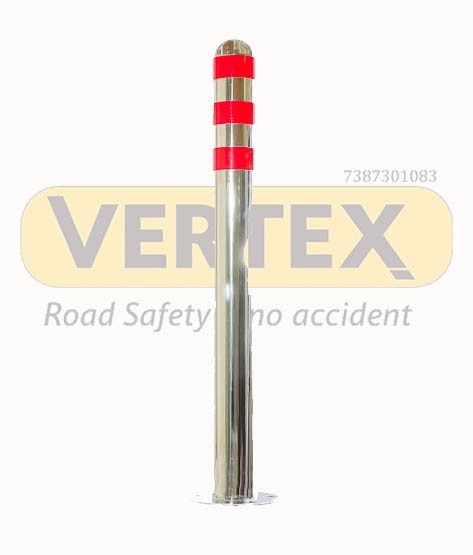 | Stainless Steel Bollard remium SS 304/316 bollard with 100% anti-skid brushed finish, corrosion-resistant, and high-visibility reflective bands – ideal for pedestrian... View product → |
Frequently asked questions
How do I choose the right stainless steel bollard for a site?
Classify the exposure first: use decorative bollards for appearance, pedestrian and parking-control bollards for access management, and a tested crash-rated system for vehicle-impact protection.
What is the difference between fixed, removable and powered bollards?
Fixed bollards provide permanent protection, removable bollards allow occasional vehicle access, and powered bollards support controlled access through automated raising and lowering.
Are stainless steel bollards automatically crash-rated?
No. A polished stainless steel tube is not a crash barrier. Verify the tested bollard, foundation, installation method and vehicle-impact performance as one complete system.
What should a bollard installation scope include?
Request the bollard dimensions, spacing plan, foundation detail, anchoring method, surface reinstatement, testing responsibilities and handover documents in writing.
Keywords