A “V50” label does not tell a Delhi site manager whether a modular rubber unit is suitable for cars, forklifts, trucks, basement ramps or public-road traffic. By checking the installed dimensions, vehicle loads, layout, anchoring and operating speed, you can decide where it belongs, where another treatment is safer, and what a comparable installation quotation must include.
Key takeaways
- Confirm installed height, profile, width and load rating before ordering.
- Use V50 breakers on private low-speed roads, not high-speed approaches.
- Keep pedestrian routes, drainage, signs and vehicle clearances unobstructed.
- Compare fixings, reflectors, installation scope and warranty in every quotation.
What the V50 specification must confirm before you choose it
V50 usually means a nominal 50 mm-high modular rubber speed breaker, not a complete Indian road-safety specification. The number does not confirm the profile, width, load capacity or suitability for a Delhi factory road. Treat it as a catalogue label until the supplier provides the installed dimensions and traffic limits.
Label or evidenceWhat it confirmsWhat it does not confirmV50 model nameA stated product family or nominal 50 mm heightActual height, ramp profile, width, material or load ratingProduct drawingHeight, module length and width, end pieces, bolt pattern, mass, anchor spacing and maximum installed widthApproval for a public road or suitability for every vehicleLoad declarationPermitted vehicle class, axle or wheel load and design speedPerformance on a cracked, weak or uneven substrateIRC:99-2018 assessmentThe road hump needs suitable geometry, signing, marking, location and target-speed controlAutomatic approval to install a modular unit on a public road
Ask for the drawing, material specification and fixing schedule before comparing quotations. Check whether the unit is designed for passenger cars, vans, forklifts, reach trucks, loaded trucks or trailers; the largest and heaviest vehicle governs. Wheel loads and turning forces can crush rubber, tear bolt holes or pull anchors from concrete.
For a rubber speed breaker v50 delhi purchase, specify total finished height, approach length, lane coverage, tapered end geometry, gap tolerance, anchor diameter and spacing, permissible vehicle class and design speed. A 50 mm rise with a sharp edge can still damage low-clearance vehicles.
On a public road, obtain the road-owning authority’s approval; a purchase order is not permission.
Where a V50 works on Delhi factory premises—and where it does not
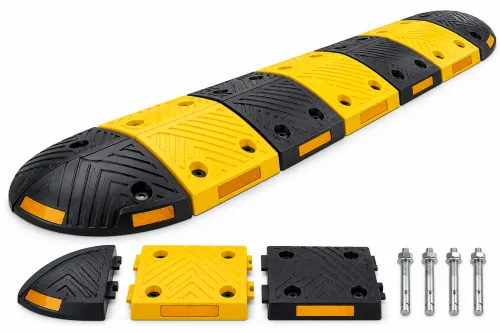
A V50 usually means a nominal 50 mm-high modular rubber unit, not a complete road-hump design. Before matching it to a Delhi factory, obtain the drawing showing height, width, module length, end taper, profile shape, bolt pattern, mass and load rating.
A sharp leading edge can damage low-clearance cars even when the rise is only 50 mm.
Factory locationSuitable useCheck before approvalGate approach or internal roadCars, vans and light commercial vehicles entering a controlled low-speed zoneSet the target speed, provide warning signs and confirm vehicle clearancePedestrian crossingSlowing mixed traffic before the crossingAdd lighting, markings and a protected walkway; the hump alone does not protect pedestriansLoading bay or dispatch yardOnly when the unit is rated for the largest loaded vehicleCheck axle loads, wheel spacing, turning forces and anchor pull-out resistanceRamp, fire-access route or trailer pathUsually unsuitableAvoid obstructing drainage, emergency movement, trailer clearance or gradient transitions
For a rubber speed breaker for factories Delhi sites, size the product against the largest and heaviest vehicle, not the average car. Forklifts, reach trucks and loaded trailers can crush rubber, tear bolt holes or pull anchors from weak concrete.
Do not use a V50 on a public Delhi road without the road-owning authority’s approval. IRC:99-2018 requires the hump’s geometry, location, signs and markings to match the road and target speed. At an unauthorised-vehicle entrance, pair speed control with a boom barrier, bollards or a controlled gate; a hump cannot provide access control.
How to use a V50 in Delhi parking areas without creating new hazards
Use a 50 mm-class V50 in low-speed car and light-van areas, not as a universal gate treatment. A 50 mm rise can still strike low-clearance cars if the approach is steep or the leading edge is abrupt.
For a rubber speed hump for parking areas Delhi, require a drawing stating ramp geometry, tapered ends, module width and installed length, then check the target speed and vehicle clearance.
LocationSuitabilityRequired layout controlVisitor parking lanesSuitable for car-speed controlKeep it across the full lane, with signs, contrast markings and clear pedestrian sightlinesShopping-complex drivewaysSuitable before pedestrian crossing areasUse tapered ends and lighting; do not place it where queues will block an entranceBoom-barrier approachSuitable for reducing approach speedPosition it before the barrier, without obstructing barrier swing, ticket access or queuing spaceBasement rampsUsually unsuitableAvoid steep transitions; use ramp geometry and clearance checks insteadLoading bays and fire-access routesUnsuitable for routine placementPreserve turning paths, emergency access and clearance for service vehicles
- Install the hump only inside the controlled private lane. A public-road placement requires the road-owning authority’s approval; a purchase order does not make a 50 mm module an IRC:99-2018-compliant road hump.
- Keep pedestrians on a separated, illuminated walkway. Add wheel stops or bollards where reversing vehicles could reach the walking line.
- Mark the hump before vehicles reach it, and inspect it after installation for loose bolts, lifted ends, drainage blockage and tyre-scraping complaints.
Installation details that determine whether the treatment stays safe
Specify the pavement, anchoring, visibility and drainage details before drilling; a rubber profile alone cannot prevent movement or vehicle damage. Identify the surface as sound concrete, asphalt or pavers. Remove loose material, repair cracks and ruts, clean and dry the fixing zone, and level high spots so every module sits flush.
Pavers need a prepared concrete strip or an engineered fixing arrangement; deteriorated asphalt will not hold anchors reliably.
The work order should state:
- Surface preparation: permitted substrate condition, repairs, cleaning, level tolerance and edge treatment.
- Fixing: anchor type, diameter, hole depth, embedment, spacing, washers and tightening torque for that substrate. Require sealed holes where water could enter, plus end pieces and firm transitions.
- Visibility: black/yellow or another approved contrast, reflector type, retroreflective marking, night-visibility check, and responsibility for cleaning or replacement after dust, oil and tyre wear.
- Drainage and access: preserve the pavement fall, keep drain inlets clear, prevent ponding at the modules, and maintain a continuous pedestrian route. Do not place the installation across an accessible ramp, turning apex or fire-access route.
- Handover inspection: record flush seating, anchor torque, module joints, end transitions and surface damage.
Inspect again after the first period of traffic and after heavy rain. Tighten or replace moving anchors, reset lifted modules, clear blocked drainage and renew markings before poor visibility or a trip hazard develops.
How to compare a V50 supplier quotation for a Delhi site
A search for v50 rubber speed breaker supplier delhi is only the starting point. Before comparing prices, demand a site-specific quotation based on the largest vehicle, axle load, target speed, pavement condition and installed lane width—not the V50 name alone.
Ask for these documents and cost lines:
- A dimensioned drawing showing finished height, approach length, module width, end-piece shape, bolt-hole pattern, anchor diameter and spacing, mass, material and load rating.
- A site assessment recording concrete or asphalt thickness, cracks, drainage, levels and the proposed fixing method.
- Separate prices for modules, end pieces, anchors, freight, installation, GST, road markings and civil repairs.
- An installation method stating drilling depth, tightening procedure, surface preparation, alignment and inspection records.
- Warranty duration, exclusions, inspection frequency, replacement-module price and response time for loose anchors, crushed edges or damaged reflective markings.
Vertex Road Safety Products should provide these details before you treat its quotation as comparable with another bidder’s.
Quotation itemDemandWhy it mattersProductInstalled dimensions and vehicle class“V50” does not prove two products matchInstallationLabour, anchors and substrate repairs itemisedA low price may omit the fixing systemSupportWarranty exclusions and replacement termsDamage from trucks or anchor pull-out may be excludedAuthorityWritten approval where a public road is involvedA purchase order does not replace road-owner permission
Reject any quote that gives only a per-metre figure or says “heavy duty” without a stated load rating. For a factory yard, check the rating against loaded trucks, forklifts and trailers, not the average car.
Related product
 Rubber Speed Breaker V50 Delhi Make
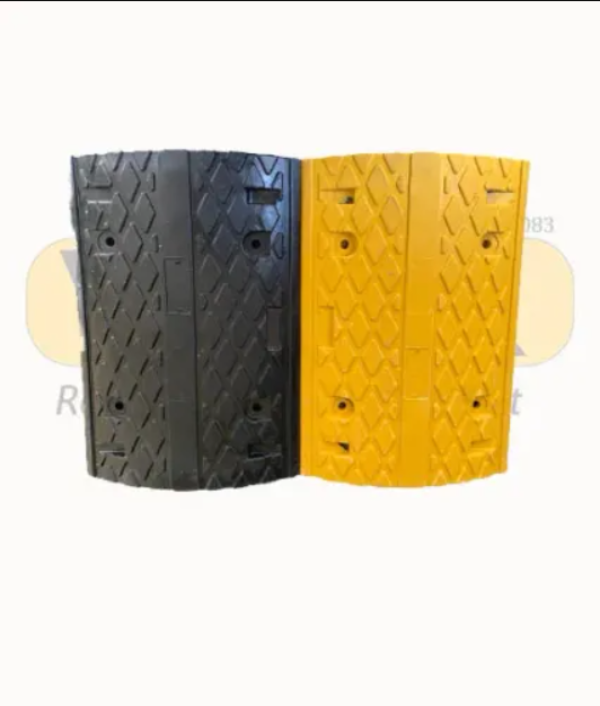
We are manufacturer of Vertex Make High Quality Rubber Rumble Stripes, which are used to reduce and control the speed limit of vehicles.
Frequently asked questions
- What must a V50 specification confirm before purchase?
- Ask the supplier to state the installed height, profile, width, module length, load rating, material, fixing method, reflectors and traffic-speed limit. V50 normally identifies nominal height, not a complete road-safety specification.
- Where does a V50 rubber speed breaker work on a Delhi factory site?
- It suits private, low-speed approaches such as factory yards, loading-area entries, internal roads and controlled driveways. Do not use it where traffic speeds, heavy axle loads, emergency access or road geometry exceed the supplier's stated limits.
- How can a V50 speed breaker be used safely in Delhi parking areas?
- Install it only where drivers have clear sight distance and enough room to slow down. Add warning signs, reflective markings and adequate lighting, and keep it away from ramps, pedestrian crossings, drainage channels and tight turning points.
- What should a Delhi V50 supplier quotation include?
- Compare the number and dimensions of modules, rubber compound, load rating, anchors, end caps, reflectors, signs, installation, surface preparation, traffic management, taxes, warranty and post-installation inspection.
Keywords