A cone plate helps only when its wording, visibility, mounting and position give drivers enough time to understand an instruction and act on it. By the end, you will be able to select the message, specify the plate and integrate it with signs, tapers, barriers and pedestrian routes without treating it as a substitute for a complete traffic-control layout.
Key takeaways
- Use “SLOW,” “DIVERSION,” “LANE CLOSED,” or “KEEP LEFT” at the decision point.
- Specify visibility for daylight, dust and monsoon conditions before ordering plates.
- Treat the plate, bracket and cone as one impact-resistant assembly.
- Remove cracked, loose, faded or confusing plates before they misdirect traffic.
Choose a short action message for the decision point
Use the shortest instruction that tells a driver what to do at the hazard. For cone message plates for safety in Pune, choose “SLOW” for an active work zone, “DIVERSION” when the route changes, “LANE CLOSED” when traffic must leave a lane, or “KEEP LEFT” when the safe path is on the left.
Use “NO ENTRY” only where vehicles must not cross; use “MEN AT WORK” as a hazard warning, not as a substitute for a movement instruction.
| Message | Decision it communicates | Use at a Pune site |
|---|---|---|
| SLOW | Reduce speed immediately | Workers, excavation, dust or a queue ahead |
| DIVERSION | Follow a changed route | Traffic redirected around the work |
| LANE CLOSED | Leave the affected lane | A taper or blocked lane begins ahead |
| KEEP LEFT | Pass on the left side | The right side is obstructed |
| NO ENTRY | Do not enter this approach | A gate, road or work area is closed |
Add Marathi alongside English when drivers, riders or pedestrians using the approach are likely to read Marathi more quickly. Do not shrink Marathi into an unreadable second line: both versions need clear lettering, strong contrast and the same visual priority.
If bilingual wording makes the plate crowded, use a larger plate or a separate advance sign.
Cone signage for construction sites in Pune is supplemental guidance. Give drivers advance warning before the taper, and never let a plate hide the cone’s reflective bands or narrow a permitted pedestrian route.
Specify visibility for dry daylight, dust and monsoon traffic
A driver needs enough distance to detect the plate, read the action, and move before the taper or hazard. Specify the viewing distance from the driver’s approach—not from the cone—and test the complete assembly in headlamps, dust and rain.
1. Set the design distance at 60 metres for approaches moving at urban-road speeds; use 75 metres where traffic arrives faster or queues form suddenly. At that distance, specify uppercase letters at least 100 mm high for a short message. Use 125–150 mm letters when the plate carries both Marathi and English.
If the full wording cannot be read at the target distance, shorten it or add an upstream sign.
2. Use strong contrast: black letters on a fluorescent yellow or orange background for daylight. Keep a clear margin around each line and do not squeeze bilingual text into narrow type.
The traffic cone message plate benefits disappear when cement dust, mud or monsoon splash turns the background grey, so allow space for wiping and inspect it during every shift.
3. Cover the message with outdoor-grade retroreflective sheeting that returns vehicle-headlamp light without hiding the cone’s reflective bands. Do not rely on a torch or an unshielded lamp aimed at drivers.
At night, add a correctly positioned work-zone lamp only when headlamp reflection is insufficient; control glare and keep the cone visibly separate from the plate.
Cone message plates for safety in Pune are supplementary. Retain advance warning, a formed taper and a protected work area. Clean the face after dusty work and heavy rain, then replace peeling, faded or permanently stained sheeting.
Match the plate, bracket and cone as one impact-resistant assembly
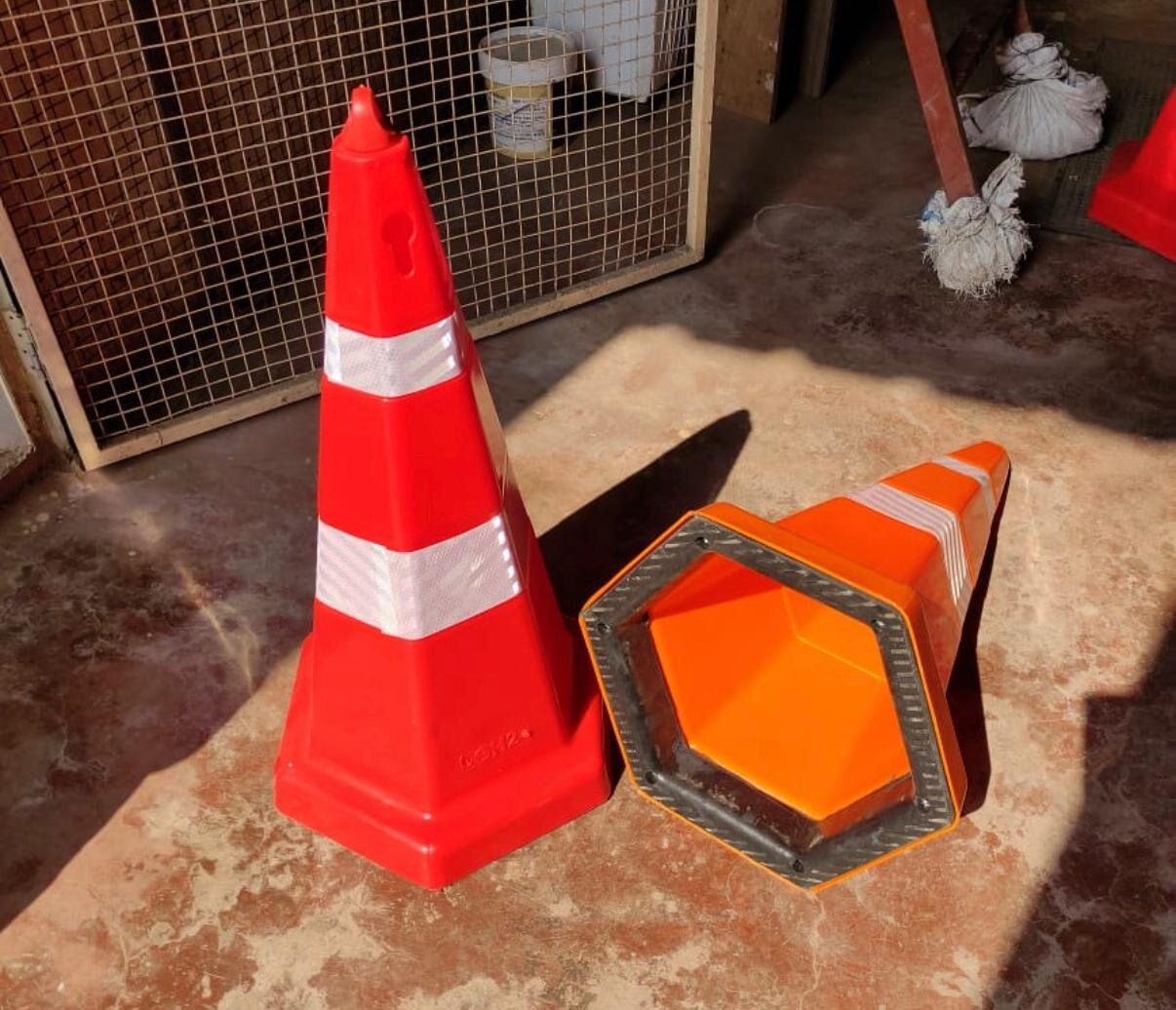
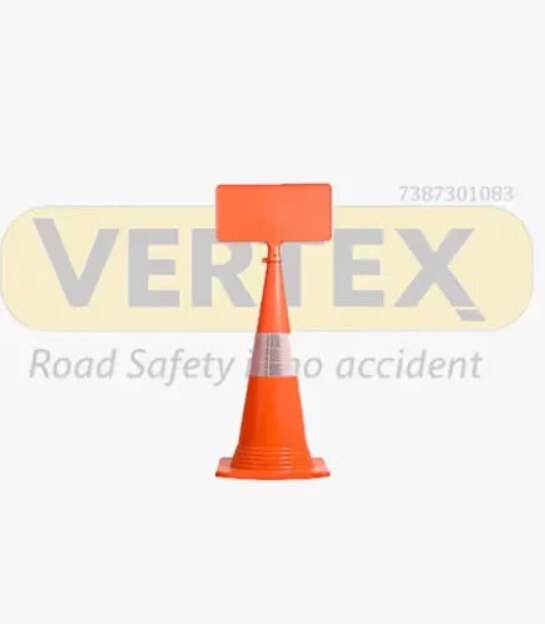
A custom cone message plate fits only when its bracket matches the chosen cone, not merely when it slips over the tip. Measure the cone’s top and mounting zone, then record the plate’s dimensions and weight. Standardise one plate-to-cone interface across the site; otherwise a heavy plate can end up on a small, light cone.
Specify these checks before approval:
- The bracket grips without crushing the cone and stays locked under site use and vehicle turbulence.
- The plate leaves every retroreflective band visible and does not make the cone appear as an unmarked solid obstruction.
- The base remains stable in cross-wind, beside moving buses and during monsoon water flow; test it in the actual deployment position, not on a sheltered floor.
- The plate uses flexible polymer or another controlled-flex material, with rounded edges and no sharp projections.
- The attachment breaks away or folds safely under a vehicle strike instead of turning the cone into a rigid signpost.
Ask for a sample assembly and inspect it in daylight and headlamps after dust or cement residue is applied. Reject any combination that tips, rotates the message away from approaching traffic, exposes a bent bracket or leaves the plate projecting after impact.
When evaluating road safety cone accessories in Pune, Vertex Road Safety Products should document the cone model, interface dimensions and test conditions rather than supply a plate as a standalone item.
Related product
 | Cone Message Plate Cone Message Plates are designed for effective traffic management and control. View product → |
Place and repeat plates within a complete traffic-control layout
Count plates by approaching traffic streams and decision points, not by cone count. Give each approach one plate where drivers must change speed or path, then repeat it at the taper and again at a queue, excavation, gate or obstruction where the instruction could be missed. A two-way closure needs coverage for both directions.
Face each plate squarely toward approaching drivers, with its message perpendicular to the traffic path. Do not angle it along the road, hide it behind a cone, or cover the cone’s reflective bands. The main traffic cone message plate benefits disappear if dust, monsoon splash or headlamp glare makes the plate unreadable.
Build the layout in this order:
- Put an advance sign far enough upstream for detection, reading and braking; use the cone plate as confirmation, not as the first warning.
- Form the taper before the closed area and keep cone spacing and lateral clearance consistent; plates cannot repair a weak taper or a misleading channelising line.
- Place barricades at the work limit, with lamps visible at night and unobstructed by plates or cones.
- Keep the plate line out of the pedestrian route. Provide a continuous, detectable, reasonably level temporary footway without pushing pedestrians into live traffic.
For cone signage for construction sites in Pune, add plates at every approach where the route changes, but do not attach one to every cone unless the design specifically requires repeated guidance. Use a standalone sign or larger board when drivers need information before the cone line comes into view.
Know when a cone plate is the wrong sign and remove failures
Use a standalone reflective sign when drivers need advance warning before the cone line, taper, queue or excavation. A barricade board belongs at a closure or protected work boundary; an arrow board suits a lane shift or merge that needs active directional guidance.
Use pavement markings when the intended path must remain clear along a longer route. A cone plate is supplemental, not a substitute for any of these.
Inspect road safety cone accessories in Pune before each shift, after a vehicle strike or relocation, and after heavy rain or strong wind. Remove any item that fails this checklist:
- Discard a plate with faded text, peeling reflective sheeting, cement residue, dust or monsoon grime that reduces contrast or headlamp return. Clean it only with a method that does not scratch the sheeting.
- Remove a plate with a cracked substrate, sharp edge, bent bracket, loose fastener or mounting hole enlarged by movement.
- Reject a plate that covers the cone’s reflective bands, sits crooked toward approaching traffic, or makes the assembly tip, spin or behave like a rigid obstacle.
- Keep incompatible fittings out of service. Standardise the plate-to-cone interface and verify the cone is large and heavy enough for that plate.
- Replace a custom cone message plate when Marathi and English no longer remain readable at the specified distance; never compensate for poor legibility with compressed lettering.
Record the inspection result and quarantine failures instead of returning them to the accessory stack.
Frequently asked questions
What message should a cone plate display?
Choose the shortest instruction that tells drivers what to do at the hazard: “SLOW,” “DIVERSION,” “LANE CLOSED,” or “KEEP LEFT.”
What visibility should cone message plates provide in Pune?
Specify legible contrast and visibility for dry daylight, construction dust and monsoon traffic, then check the plate from the driver’s approach distance.
Why match the plate, bracket and cone together?
A matched assembly reduces loose fittings, cracked plates and unstable cones after contact with vehicles or site equipment.
Where should you place cone message plates?
Place them at the decision point and repeat the instruction through the traffic-control layout when drivers need another confirmation.
When is a cone message plate the wrong sign?
Use a larger, more prominent traffic sign when drivers need advance warning, lane-transition guidance or information beyond a cone’s viewing area.
Keywords